Ragland: A Natural Handwritten Font for Authentic Maker Brands
It’s 10 a.m. on a quiet Tuesday—I’m holding a freshly printed candle label in my hand, still warm from the printer. The soy wax blend inside is lavender + vanilla, and the jar has that soft matte finish I love. But it’s the label that catches my eye first: Ragland tracing the scent name in gentle, uneven strokes—slightly tilted, quietly confident, like something written with care, not code. That’s when it clicks: this isn’t just typography. It’s texture. It’s tone. It’s the quiet hum of authenticity I’ve been chasing across every product I make.
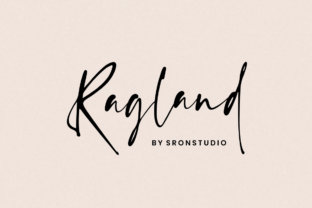
Ragland is a natural handwritten font—no rigid loops, no over-polished curves. Its organic feel comes from subtle variation in stroke weight, slight baseline wobble, and a relaxed rhythm that breathes like real handwriting. It doesn’t shout. It leans in. That “casually smart” quality makes it ideal for makers who want warmth without whimsy, personality without pretense.
I first used Ragland on a set of seasonal greeting cards—simple kraft stock, blind debossed borders, and short phrases like “You’re My Person” and “Warmest Wishes.” With Ragland as the headline, each card felt personal, intimate, like a note slipped into a friend’s coat pocket. No extra embellishment needed. Just ink, paper, and the quiet authority of a well-chosen script font.
For wedding stationery, Ragland shines on welcome signs, envelope calligraphy, and ceremony programs. Its lowercase ‘g’ and ‘y’ have gentle descenders that flow beautifully alongside floral motifs or linen textures. Because it’s designed as a display font—not meant for long paragraphs—it works best for names, titles, and short decorative lines. Think “Ella & James • October 2024” on a chalkboard-style welcome board, or “Hand-poured • Small Batch” stamped beside a logo on a boutique gift tag.
On physical products, Ragland adds tactile credibility. I tested it on cotton tote bags using heat-transfer vinyl—cut clean at 12pt with my Cricut Maker, even with its delicate entry/exit strokes. For sticker sheets, I kept text above 14pt to preserve legibility on 1.5-inch die-cuts. And for digital printables—planner pages, wall art PDFs, printable quote cards—I paired Ragland with a light sans serif (like Montserrat Light or Inter) for body text. The contrast feels intentional, balanced, editorial.
That pairing matters. Ragland thrives when grounded. Try it with a clean, open sans serif for shop banners or listing images—where clarity meets charm. Or layer it over a soft serif like Merriweather for vintage-inspired packaging. Avoid stacking it with other script fonts unless you’re intentionally creating layered texture (e.g., Ragland for a name, a bolder script for “Est. 2022”). As a standalone, it carries weight. Paired thoughtfully, it gains dimension.
Real-world readability depends on context—and Ragland delivers where it counts. On candle labels, it reads clearly at 16–20pt on 2×3 inch stickers. On mugs? Best at 24–32pt for curved surfaces—especially if you’re printing with sublimation or ceramic decals. For SVG files intended for cutting machines, always check the included OTF files: Ragland includes standard ligatures and stylistic alternates, but avoid relying on discretionary swashes for small-scale cuts unless you’ve tested them at actual size first.
I also use Ragland for digital downloads—wall art previews, Canva-ready templates, and planner bundle covers. Because it’s part of the Script Amp collection, it ships with consistent spacing, optimized kerning pairs, and full Latin character support (including accents for French, Spanish, and German). That multilingual readiness matters when designing holiday tags (“Joyeux Noël”) or bilingual wedding signage. And yes—it’s licensed for commercial use, so you can embed it in editable Canva templates, include it in SVG bundles, or use it on physical goods you sell—no hidden restrictions.
Seasonal work is where Ragland truly flexes. Last fall, I designed a set of farmhouse-style pumpkin patch signs—“Pick Your Own,” “Honeycrisp Apples,” “Hot Cider Here”—all in Ragland, then distressed the edges digitally before printing on weather-resistant vinyl. The font’s organic imperfections made the signs feel gathered, not generated. This winter, I’m sketching holiday mug designs: “Cozy Season,” “Merry & Bright,” “Gingerbread Hours”—each phrase sized to fit the curve of a ceramic handle, all in Ragland’s natural flow.
What surprises me most is how consistently Ragland elevates perceived value. Customers don’t comment on the font by name—but they do say things like “This feels handmade,” or “The packaging looks so thoughtful.” That’s Ragland doing quiet work: reinforcing brand identity through consistent, human-scaled typography. It tells your audience, without saying a word, that you pay attention—to scent blends, stitch tension, paper grain, and yes—even the shape of an ‘a’.
Before you download or license Ragland, take five minutes to open the preview file and scroll through the character set. Look for alternate glyphs (some versions include flourished capitals or contextual swashes), check line height behavior in your design app, and test how it renders at 10pt in a mockup thumbnail—because Etsy listing images live small. If you’re using Silhouette Studio or Cricut Design Space, confirm the font installs cleanly and cuts without jagged joins. Most importantly: print a test label, stick it on a real product, step back, and ask—does it feel like *mine*?
Ragland isn’t flashy. It won’t dominate a trend report or trend-hop across Pinterest feeds. But it stays. It settles in. It belongs on the shelf beside your favorite ceramic mug, tucked into the corner of a handmade card, pressed into the foil stamp on a gift box lid. It’s the kind of font that doesn’t draw attention to itself—until someone pauses, smiles, and says, “This feels just right.”
- Use Ragland for short, meaningful phrases—not body copy
- Pair it with a neutral sans serif or gentle serif for balance
- Test cut sizes early—12pt minimum for vinyl, 14pt+ for small stickers
- Leverage its organic flow for seasonal, artisanal, and heartfelt branding
- Verify commercial licensing and file formats before bundling into digital products